From the Deck
The Stargazer
They check the forecast for cloud cover the way other people check it for rain. There is an app that tells them when the International Space Station goes over, and when it does they will go outside, and they will tell you, and they will expect you to come outside too. They know what the moon is doing this week without looking. In October they get quietly excited about a meteor shower that will almost certainly be rained off.
The whole hobby is standing still, outdoors, in the dark, in Britain. That fact tells you more about what to buy than anything about astronomy does.
Also try



24 ideas
Live prices from the shops, checked when you look.
So which one are they?
Rummaging.
More on buying for the Stargazer
What they've definitely already got
The telescope. Or the binoculars, or both, and the choice was deliberate — a dobsonian for deep sky, a refractor for planets, 10×50s for wide sweeps from the back garden. A second telescope chosen by someone else is a very expensive cupboard occupant. Do not buy optics. The same applies to eyepieces, which sound like a safe accessory and are not: they are matched to the scope's focal length and the observer's preferences, and the wrong one is worse than none.
They also have an app. Several. The sky-identification problem is solved and has been for a decade, so anything that promises to point out constellations on a phone screen is a duplicate.
What they do not have is comfort. Almost nobody buys their own observing chair, their own decent gloves, their own flask. They stand in a field getting steadily colder for four hours because the alternative is not standing in the field.
What actually works
Anything that fights the cold and the dark. A red-light head torch, so they keep their night vision — the single most-used object in amateur astronomy and routinely a £15 own-brand thing that dies in a season. Proper wool. Fingerless gloves that actually let them adjust a focuser. A vacuum flask that holds heat for the whole session. This is unglamorous and it is the best-received category on this card by a distance.
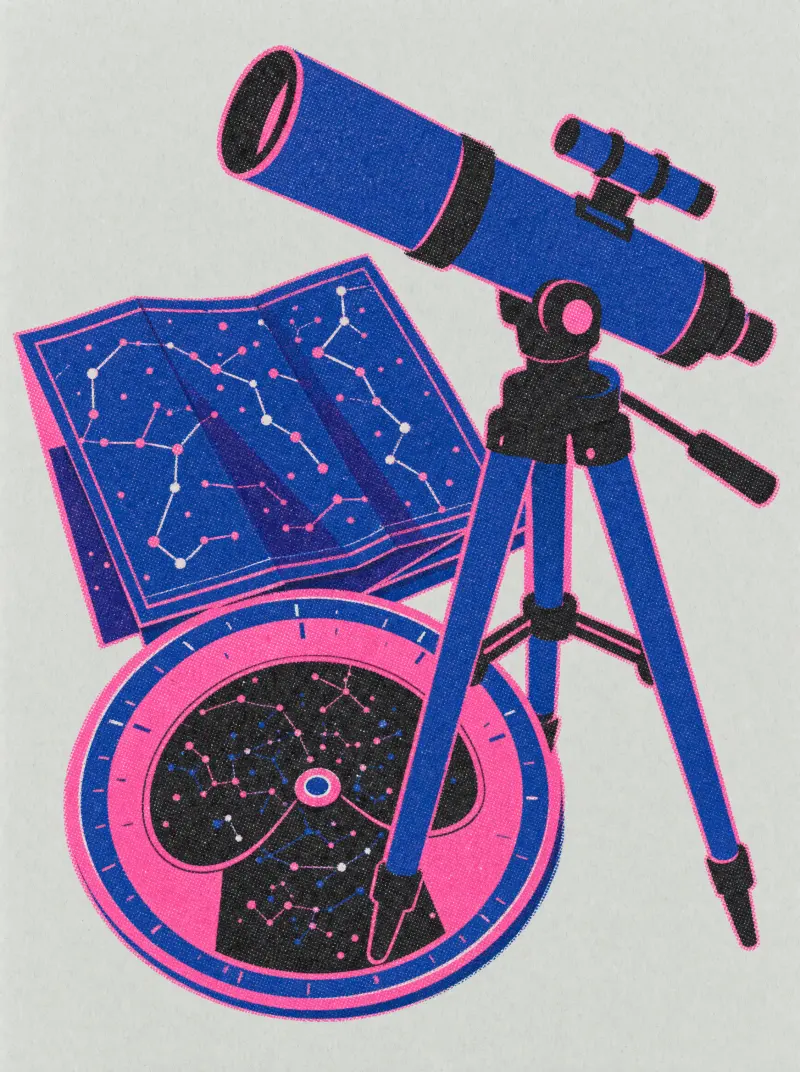
Maps and charts on real paper. A hand-drawn celestial map, letterpressed. A planisphere set for their latitude. A serious star atlas — the kind with a spiral binding so it lies flat on a table in the dark. Screens ruin night vision; paper does not, which is why paper survives in a hobby that has every reason to have abandoned it.
Instruments that are objects. A brass pocket sundial. A cast orrery. A sextant reproduction. None of these are working tools any more and everybody involved knows it — the appeal is that they are beautiful, mechanical, and about the sky. This is where the small-maker end of the internet is genuinely extraordinary.
Records of a specific sky. A print of the constellations as they stood over a particular place on a particular night. It sounds sentimental and it is, but done well — accurate, well-typeset, not covered in swirly text — it is the only gift on this list that is about them rather than the hobby.
Notebooks and logging. Serious observers sketch. A hardbound observation log with the right ruling, a set of blending stumps, a clipboard with a red light built in. Sketching at the eyepiece is one of those practices that sounds archaic and turns out to teach people to see.
What to spend
Under £30 covers the highest-hit-rate items on this entire card: a red head torch, a planisphere, a good chart. £30–£70 gets a proper flask-and-gloves setup, a fine printed atlas, or a small brass instrument. Above £100 you are into optics and mounts, and that is territory where their research beats your guess every time.
The mistake almost everyone makes
Buying a novelty telescope from a department store. It will be a 60mm refractor on a wobbly tripod with plastic eyepieces, it will be genuinely unusable, and the recipient will know within thirty seconds. If someone truly has no telescope and wants one, the answer is a decent pair of 10×50 binoculars — which real astronomers recommend constantly and nobody ever gives, because it does not look like a telescope.
Questions people actually ask
What do you buy an amateur astronomer who already has a telescope?
Everything that surrounds the telescope. A red head torch, a proper observing chair, a warm hat that works with a hood up, a star atlas on good paper. The optics are settled. The four hours in a cold field are not.
Is a telescope a bad gift?
For a beginner, no. For someone who already owns one, almost always. Telescopes are chosen for a specific kind of observing, and a second one bought by someone else usually sits in a cupboard.
What is a good astronomy gift under £30?
A red-light head torch, a planisphere for their latitude, or a well-printed star chart. All three get used on the very next clear night.
Do they want a star named after them?
No. Star-naming registries have no scientific standing and they know it, which makes the gift slightly awkward to receive. A real map of the real sky lands far better.