From the Deck
The Mushroom Forager
Autumn changes them. From late August there is a quiet checking of the weather — warm rain, then a cold night, then out early on a Saturday to a wood they will not name. They come back with a basket and a slightly smug expression, and then they take a photograph of the gills, and then they put a cap on a piece of card under a glass overnight to see what colour the spores are.
That last step is the whole personality. This is somebody who has decided to be carefully, methodically right about something where being wrong is genuinely serious, and they enjoy the rigour as much as the risotto.
Also try
24 ideas
Live prices from the shops, checked when you look.
So which one are they?
Rummaging.
More on buying for the Mushroom Forager
What they've definitely already got
A field guide, and a strong opinion about which one. Probably several, plus a regional one, plus something specialist on a single genus. A general "mushrooms of Britain" paperback is almost certainly already on that shelf. Do not buy an identification app subscription — the serious ones treat app IDs with active suspicion, because a confident wrong answer is the exact failure mode that gets people hospitalised.
Somewhere to put it all. Many foragers are still walking out with a supermarket bag, which crushes everything at the bottom and sweats the rest. They know it is wrong and have never got round to fixing it, which makes it the most reliable gap on this card.
Somewhere to dry things. Or rather, not. Most people are drying ceps on a radiator or in an oven on its lowest setting, which is fine and also slightly sad. A dehydrator, or even a set of drying screens, changes what they can keep.
What actually works
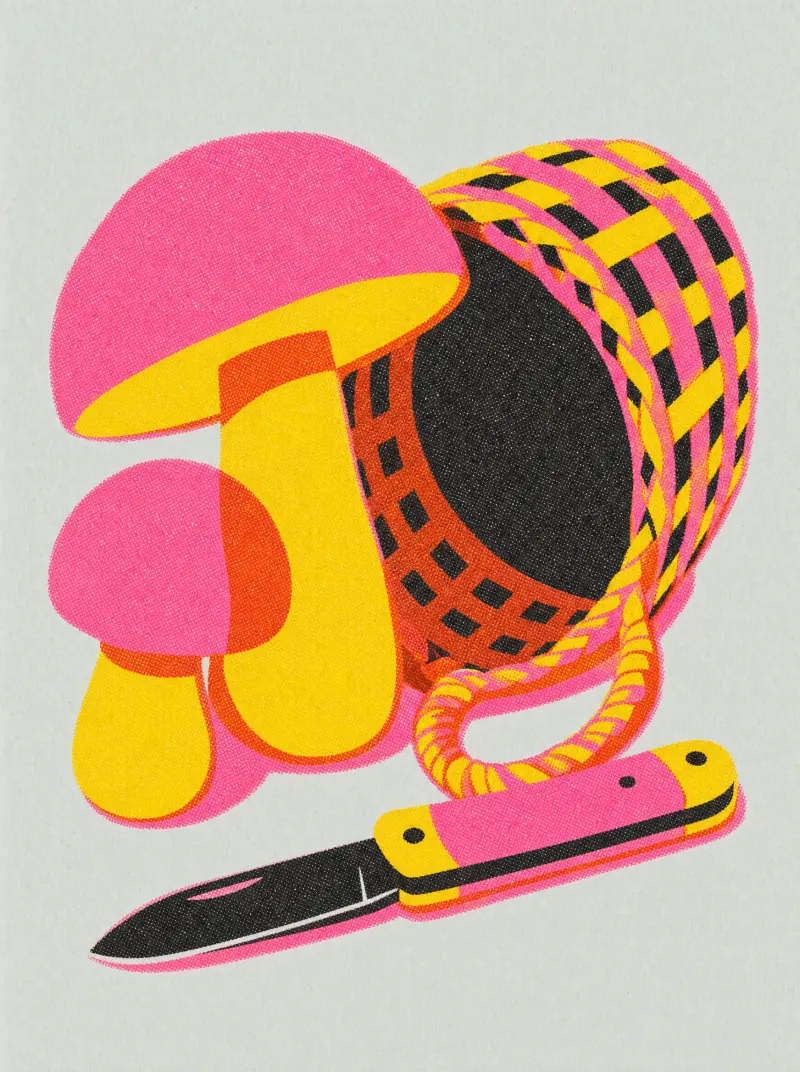
A proper basket. Open weave, willow or ash, flat-bottomed, with a handle that clears a full load. There is a real functional argument — spores drop through the weave as they walk, and the mushrooms do not sweat and collapse the way they do in a bag — and there is the fact that it looks magnificent. Splint baskets from a single maker are the best version of this.
A brush for the field. Stiff bristles for the soil, soft ones for the gills, getting leaf litter off the cap in the field. Hand-forged ones with a wooden or antler handle are the gift version. This is the single most-used object in the hobby.
Anything that helps with identification properly. Spore-print card in black and white. A jeweller's loupe or a pocket microscope for looking at gill attachment. A proper regional monograph. A notebook for recording site, substrate, date and weather, because good foragers keep records and go back to the same patch year after year.
Preserving and cooking. Drying screens, muslin, kilner jars, a duxelles pan. Foraged food is seasonal and abundant for about three weeks, so everything about this hobby ends in preservation. Salt, vinegar and good jars are a more thoughtful gift here than they sound.
Dyes and paper, for the ones who have gone further. Fungi make extraordinary natural dyes, and mushroom paper is a real craft. If they have started talking about Cortinarius in a tone that has nothing to do with dinner, this is where they are heading.
Boots, socks and a decent flask. It is a hobby conducted in wet woods in October. The unromantic gear is always welcome.
What to spend
Under £30 buys a genuinely good trug or a set of identification aids. £30–£70 gets a hand-woven basket, which is the flagship gift here. Above that you are into dehydrators and optics, both of which are useful and neither of which is a surprise-worthy object.
The mistake almost everyone makes
Buying anything with a cartoon toadstool on it. Red cap, white spots, little door in the side. That is Amanita muscaria, it is poisonous, and it has become shorthand for a whimsy that has very little to do with the actual practice of kneeling in wet leaves being careful. The aesthetic is lovely and it belongs to a different person.
The other mistake is treating the risk as a joke. "Hope it's not the last supper" on a card is a line every forager has heard and it lands, at best, thinly.
Questions people actually ask
What do you buy someone who forages for mushrooms?
A basket, a drying rack, and anything that helps with identification. Foraging is a hobby with genuinely few objects in it, which makes the good ones easy to get right.
What is a good foraging gift under £30?
A set of spore-print card, a hand-woven trug, or a regional field guide. All three are used on the very next walk.
Should I buy a mushroom growing kit?
For a forager, probably not. Growing oysters in a bag is a different hobby from finding chanterelles in a wood. For someone curious rather than committed, a kit is a reasonable introduction.
Is a basket really better than a bag?
Yes, and they will tell you why. An open-weave basket lets spores drop as you walk and stops the haul sweating and collapsing on the way home. A plastic bag ruins a morning's picking.