From the Deck
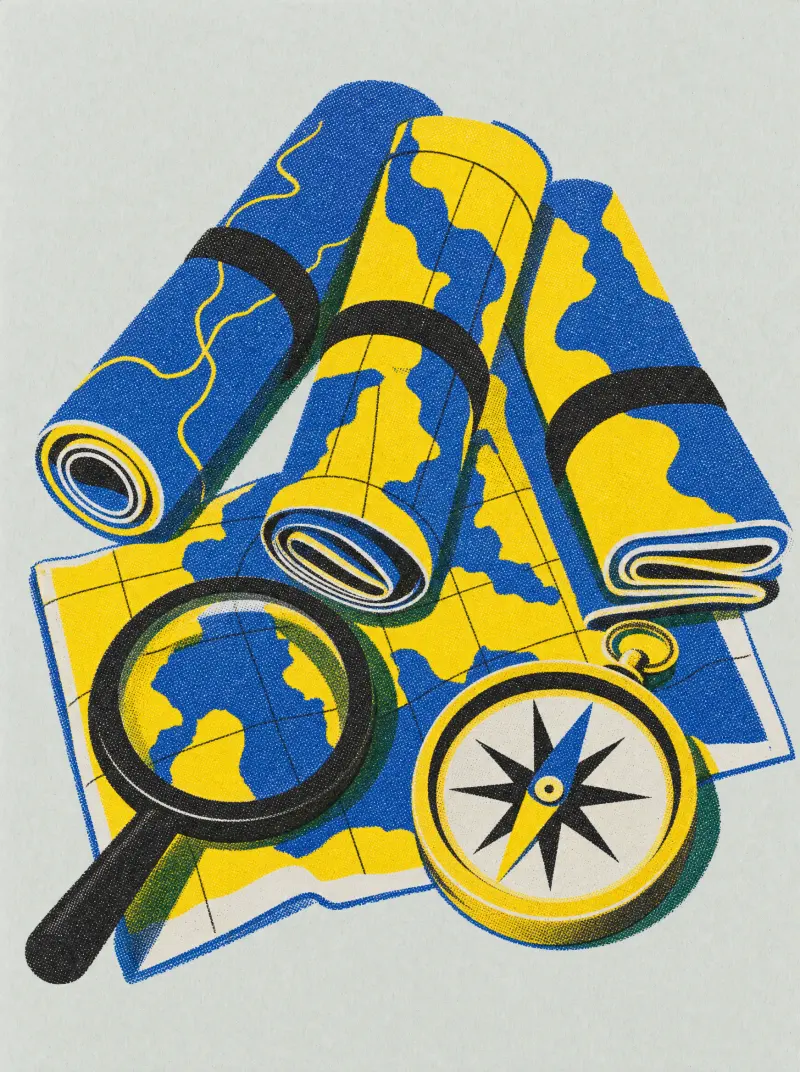
The Map Collector
They can tell you which way north is right now, indoors, without thinking about it. They have driven a route once and remembered it. And yet the house contains maps of places they have never been and have no plan to visit: an admiralty chart of a Scottish sea loch, a 1970s road atlas of a country that has since changed its name, a geological survey sheet in colours nobody would choose today.
Because the map is not for getting anywhere. It is a document of how somebody once understood a place — what they thought was worth naming, what they left out, where they guessed. That is the hobby, and it is why phone navigation did nothing to dent it.
Also try

24 ideas
Live prices from the shops, checked when you look.
So which one are they?
Rummaging.
More on buying for the Map Collector
What they've definitely already got
A road atlas and a phone. The practical navigation problem is solved and was never the point. Anything sold as a travel aid is a duplicate.
The obvious antique prints. If they have been at this a while they have seen every reproduction of the Blaeu atlas, every sepia old-world map with a compass rose in the corner, and every "vintage" print sold in a department store. Those have been printed several million times and the paper is usually bad. They will be gracious about it. They will not hang it.
Something of the place they grew up. This is the first map anybody buys, so assume it exists. The second-order version — the same place at a different date, or at a different scale, or drawn by somebody with a different agenda — is much harder to find and much more interesting to receive.
What actually works
Nautical charts. Admiralty charts and their reproductions are the sleeper hit of this whole category. They are beautiful — soundings, sandbanks, magnetic variation, all that fine numerical stippling — and they are about a kind of space most people never see rendered. Pick a coastline they have sailed, walked or holidayed on and it stops being decoration.
Geological survey sheets. The same country, drawn as time instead of geography, in colours chosen in the 1890s and never improved on. Reissues and originals are both available and both cheap relative to how astonishing they look on a wall.
Hand-drawn and illustrated maps from working illustrators. Not template generators — actual cartographic illustrators, who still exist, working in screen print and letterpress. A hand-drawn map of a single town, with the pubs and the bus routes and the bit where the river floods, is a genuinely personal object.
Detached atlas pages and county maps. The most under-priced antique on the internet. Nineteenth-century engraved county maps, hand-coloured, routinely go for less than a decent dinner because the atlas they came from was broken up. Buy from someone who states the date and where the sheet came from.
Instruments that read maps. Brass parallel rules, dividers, a proper romer, a Silva compass with a mirror. These sit alongside the collection and get handled. Also: map cases, tubes and flat files, because a collection stored in a cardboard tube behind a wardrobe is a collection quietly deteriorating.
Globes and relief models. Cast plaster relief maps, small terrestrial globes, contour models of a single mountain. Three dimensions is a different pleasure from two and most collections do not have any.
What to spend
Under £30 buys a very good single printed sheet or a small antique. £30–£70 gets a genuine nineteenth-century county map, a large screen print, or a good pair of dividers. Above £100 you are into serious antiquarian territory, where condition and provenance matter and a dealer's reputation is the whole purchase — worth it, but not worth guessing at.
Framing costs more than the map. This surprises everybody. A £25 print can easily carry a £90 frame, so if you want it to arrive ready to hang, budget for it or accept that you are giving a beautiful thing in a tube.
The mistake almost everyone makes
Buying a scratch-off world map. It is a poster with foil on it, the cartography is an afterthought, and the whole premise — a map as a scoreboard of places visited — is the opposite of why this person likes maps. They like the ones of places nobody goes.
Questions people actually ask
What do you buy someone who collects maps?
Something with a place in it they actually know. A hand-drawn map of a town they lived in, a nautical chart of a coast they sail, a geological survey of the hills they walk. Specific beats decorative every time.
Are antique maps a good gift?
Yes, and they are cheaper than people expect. Nineteenth-century county maps and detached atlas pages are widely available for well under £100. Buy from a dealer who states the date and the source honestly.
What is a good map gift under £30?
A single well-printed sheet — a letterpress town plan, a screen-printed coastline, a reissued survey map. Framing is the expensive part, not the map.
Do map people want a personalised star or city map?
Sometimes, but the bar is high. They read maps critically, so the typography, the projection and the accuracy all have to hold up. A generic template with a name printed under it will be spotted immediately.